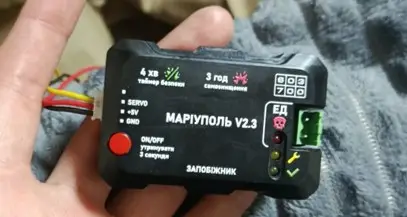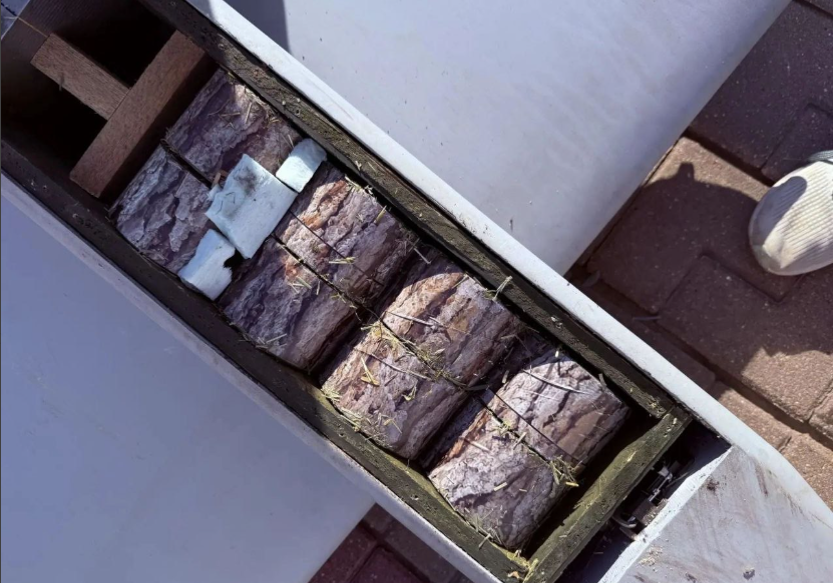
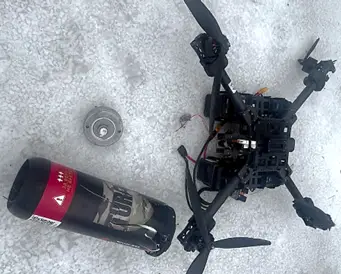

On February 25, 2026, a Russian Telegram channel disseminated documentation obtained from Russian forces operating in Ukraine, showing a weaponized Ukrainian quadcopter that had been intercepted or crashed. Alongside the drone was its fiber-optic spool compartment, within which an IED was identified. The IED consisted of an AO-2.5RT cluster submunition fitted with a Ukrainian-made “Verba FPV” initiation system, which provides a 30-minute self-destruct delay, as well as alternative initiation capabilities.
The placement of the IED within the fiber-optic cable housing, rather than on the main body of the UAV, constitutes a concealed hazard for forces encountering such systems in the field. Personnel who do not identify an evident warhead on the UAV may approach, handle, or attempt to exploit the platform for intelligence purposes, unaware that the fiber-optic cable housing contains additional hazardous components beyond the spool.
This incident, alongside other events observed in the Ukrainian theater in recent months, as well as in other combat arenas in recent years, highlights the risks posed to forces tasked with the examination and recovery of UAVs in the field, in parallel with explosive ordnance disposal procedures for the main payload. Such forces are exposed both to inadvertent detonation resulting from pre-set delay mechanisms reaching completion, and to victim-operated or RC initiation systems designed specifically to target responding personnel.
Get the full report
If you would like to get the full report, leave your details in the form below.
Please be advised we can only send reports to validated government organizations.